Explore the Legacy and Enduring Impact of Court Barn
Court Barn is Lee-on-the-Solent’s historic farmhouse. While some Conservative Clubs serve as political hubs for their areas, Court Barn was uniquely the political base for the Fareham and Gosport Member of Parliament. Following the boundary changes in 1972, Fareham and Gosport each gained their own MP. Members residing in Gosport moved to Stoke Road and acquired the old Town Hall as their social venue, while members in Fareham gathered at the High Street location. Club members at the time were offered the respective branches. The club remains affiliated with the Conservative Association.
A house was first documented in 1666 and appears on a map dating back to 1610. Although the exact date of construction is unknown, it is believed to have been built on a medieval site. The property was part of the Titchfield estate, owned by the third Earl of Southampton, but its first recorded owner was Thomas Wriothesley, the fourth Earl of Southampton. Upon his death in 1671, he left Cherque Farm and Barn Farm to his two daughters. The second owner was Lady Elizabeth Noel, wife of Edward Noel, who later became Lord Lieutenant of Hampshire. They did not reside at Court Barn. Instead, like with their other properties, they employed stewards to manage the house and land. It is likely these stewards were responsible for extending and improving the house. They also presided over the Courts Leet and Baronial, collecting rents and fines from local tenant farmers in both money and kind.
Name Origin
There were two notable barns in the Lee-on-the-Solent area. The Common Barn served as a storage place for all local farmers, common tenants, and smallholders to keep their harvests. Court Barn, on the other hand, was where the Steward directed the storage of payments in kind owed to the Lord of the Manor. This large, historic black timber barn, featuring wagon bays and a Queen post truss, stood on the east side of Court Barn farmyard opposite the farmhouse until the late 1970s. At that time, Dr. Taylor, then Conservative Chairman, arranged for it to be carefully dismantled and relocated to the Weald & Downland Living Museum in Singleton. Since 2017, the barn has served as the set for the BBC television series The Repair Shop.
In the 1760s, Arthur Young documented in his Annals of Agriculture detailed reports on local farming conditions, gathered through his correspondence with the Waller family of nearby Crofton. Court Barn appeared to be thriving during this period. The fields were enriched with cartloads of seaweed and mud, along with large amounts of urban manure sourced from the dung heaps of Gosport and Portsmouth. In exchange, the local residents were able to purchase the farm’s produce. The farm cultivated cereal crops such as wheat, barley, and oats, as well as vegetables including turnips, potatoes, and cabbage. Livestock on the farm comprised cows and sheep.
When James Chatham completed his census returns in the years 1851 and 1871, he was recorded as employing a farm bailiff along with twenty labourers who were responsible for managing the extensive four hundred acres of land at Court Barn. Meanwhile, the domestic affairs of the household were looked after either by his two sisters or by the bailiff’s wife, ensuring the smooth running of both the farm and the home during that period.
The local tenant farmers who cultivated the land on the estates were primarily families such as the Stares, Fielders, Whattams, and Lees. These names frequently appear in records and accounts over many years, indicating their long-standing presence in the area. Among them, some were quite prosperous and successful, managing to enhance and improve the farmhouse and various farm buildings substantially. It was common practice for these farms to be passed down to their sons, allowing the agricultural legacy to continue through generations, provided that the landlord gave their approval and consent for the transfer.
Over the years, only a small number of families have had the privilege of owning Court Barn. These include the Noels, the Dukes of Portland, the Delmes, and, ultimately, the Houses during the 1960s. The House farm estate underwent a major transformation in the late 1960s after the passing of Charles House. This event triggered a division of the estate that resulted in substantial changes for numerous farms, including Court Barn itself. The new owner saw the considerable potential for development land at Lee-on-the-Solent, which was a key factor that led to the decision to break up the estate.
By the year 1971, which marked a full century since those initial records were made, farming had ceased to be the primary focus of the area. Instead, the prevailing trend of the time had shifted decisively towards building development and urban expansion. The once fertile fields surrounding Court Barn, which had been dedicated for generations to growing crops and raising livestock, were now being transformed and repurposed for bricks, mortar, and new construction. The housing developments around Court Barn were so seamlessly integrated into the landscape that one of our members actually lived just 150 yards away from the building for a remarkable fifteen years without ever realising that the historic structure was there.
In the year 1966, the Fareham and Gosport Conservative Association seized the opportunity to acquire the farmhouse, including the surrounding farmyard paddocks, beautifully maintained gardens, various outbuildings, and the historically significant black timbered Court Barn. Shortly after this important purchase, they successfully secured a dependable tenant to occupy and maintain the property.
Court Barn became the home of the newly established Court Barn Conservative Club. The club leased the spacious cellars and other facilities from the Fareham and Gosport Conservative Association, which also used some rooms as their headquarters. Conveniently located on the border between Fareham and Gosport Boroughs, it was a practical and central purchase. The price was £11,250, and the rent provided the Association with a steady income. At the time, no one could have anticipated that in 1972, Gosport Borough would become a new parliamentary constituency, while Fareham’s boundaries would shift away from its populous neighbor to include the rural areas of north Fareham. The 1970 general election marked the first successful Conservative campaign coordinated from Court Barn, resulting in Dr. Reginald Bennett being re-elected for the final time as MP for the combined Fareham and Gosport constituency. Subsequently, Fareham sold its half of Court Barn to the thriving Court Barn Conservative Club, leaving Gosport with the other half. In the late 1980s, the Gosport Conservative Association also chose to sell its share to the club and relocate to Gosport Town.`
The Maintenance Nightmare Unveiled
In 1977, Court Barn was designated a Grade II listed building. As a result, the Committee of the Court Barn Conservative Club is responsible for its repair and upkeep, a cost that increasingly impacts the Club’s profitability. While some public funding is available through grants from local authorities and English Heritage, the majority of expenses must be covered by the owners—the club members. Unfortunately, the absence of regular surveys in the past created a significant backlog of necessary repairs. To address this, a comprehensive maintenance and refurbishment program has been undertaken to preserve the building in good condition.
The front windows of the house have recently been replaced at a total cost of approximately £15,000, which is notably £4,000 more than the original purchase price of the entire house. In addition to this, the side windows and several of the rear windows have also been updated to improve the overall appearance and functionality. However, because all window replacements must perfectly match the historic character and style of the building, it has become increasingly difficult to find craftsmen or companies with the specialised skills and expertise required to carry out this type of work effectively and accurately.
The Pond and the Cellar
Of particular historical and local interest, located right next to the farmyard of Court Barn, which today serves as the club’s car park, there once existed a large and well-stocked pond teeming with fish. Back in the 1950s, a devastating barn fire caused significant damage, resulting in the entire pond being drained of its water, which tragically led to the destruction of all the fish that had lived there. Following this unfortunate event, the pond was eventually filled in and ceased to exist as a water feature.
Another truly fascinating and remarkable feature of Court Barn is the vast cellar located beneath its impressive and spacious central hall. This cellar is notably unvaulted and unlined, giving it a raw, authentic character that adds to the building’s historic charm. In the past, when the cellarman would switch on the lights down in the cellar, the light would shine up through the long, straight floorboards above—a uniquely captivating sight, especially at dusk. During this magical time, the embers of the great log fire in the fireplace would glow a warm, inviting red, creating an atmosphere that was both cozy and enchanting. Unfortunately, this beautiful effect no longer occurs today, as the floor has since been carpeted, preventing the light from shining through in the same way.
Description of the Court Barn Building
This summary is intended for a general audience. A comprehensive, detailed professional report, including precise technical terminology, was prepared by the architect and submitted to the Court Barn Conservative Club and the Gosport Borough Council’s Planning Department. This report accompanied the 1990 application for grant funding to support the building’s repair and conservation works.
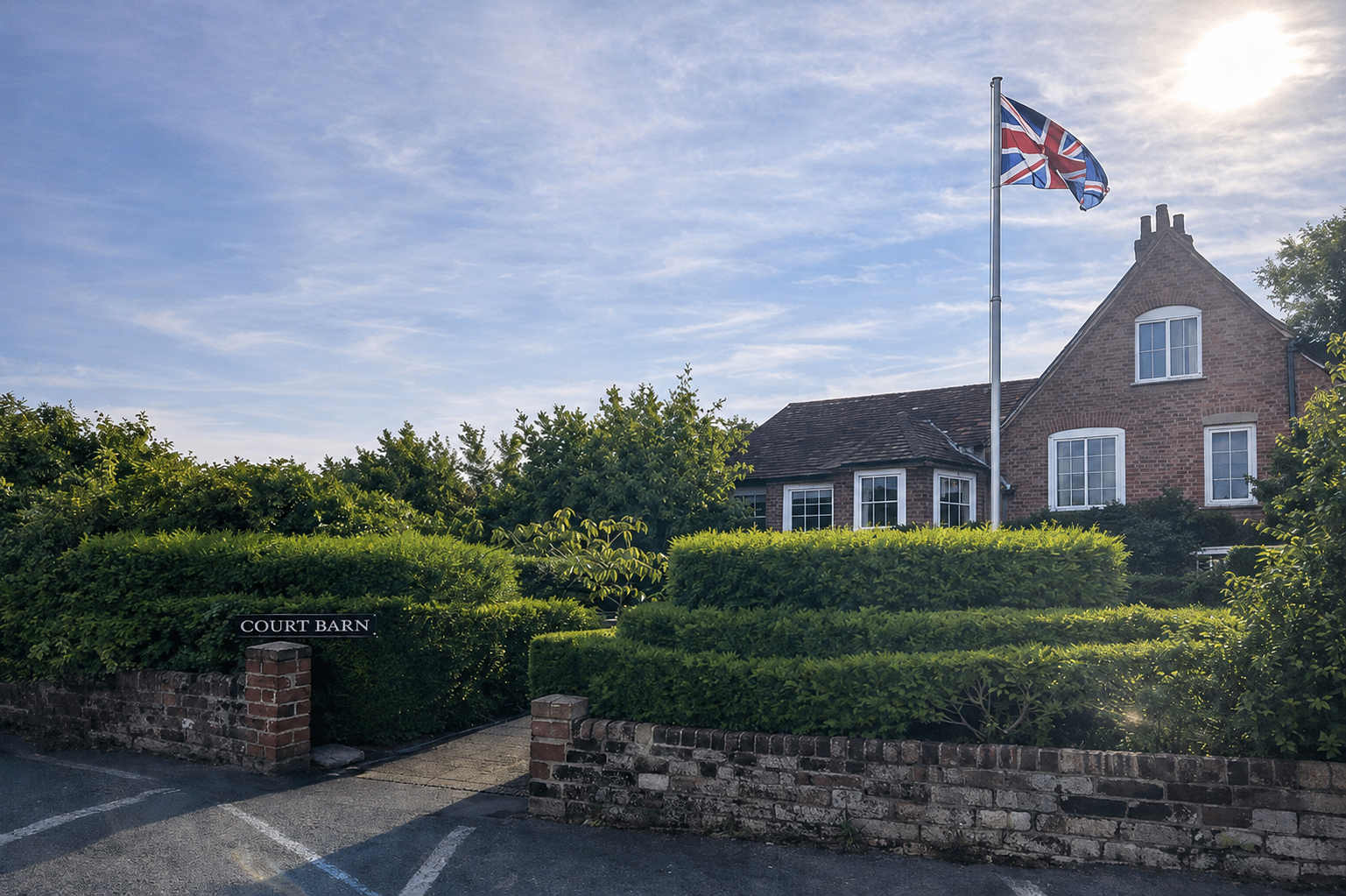
A quick glance at a picture of Court Barn immediately reveals the enduring and evolving influence of human hands shaping its structure over many centuries. The architectural style of the north wing, with its distinctive dormer windows, presents a striking contrast to the south wing, which boasts an elegant and gracefully curved triple-lit bay window. When the building was first constructed, it featured six chimneys, all meticulously crafted at the renowned Funtley Brick Works. However, as time has passed, only three of these original chimneys remain, with one still actively in use today in the cozy bar area.
A Guided Tour
On the ground floor, right next to the main hall, you will find the Presidents Lounge. This spacious and bright room is filled with natural light and features a charming bay window that provides a lovely view of the front garden. By contrast, located on the opposite side of the hall, the Barn restaurant offers a completely different ambiance with its dark panelled walls and striking black-beamed ceiling, creating a cozy and intimate atmosphere.
The kitchen underwent a comprehensive modernisation in 2019 and currently serves as the home of Court Barn Catering. It is equipped with state-of-the-art equipment and top-of-the-line facilities, designed to meet the highest standards of culinary service and efficiency.
The Lounge Bar is situated in the north wing, encompassing both the spacious club room and the welcoming bar area. From the bar, guests have the opportunity to step outside and access the beautifully landscaped gardens. These gardens featured a charming and inviting seating area, thoughtfully nestled within the carefully maintained and picturesque grounds, offering a perfect spot for relaxation and enjoyment.
In the hallway, the staircase leads to the upstairs office and the club steward’s quarters. Originally straight, the staircase now ascends in two stages. It includes a restroom area, and a door opens to the loft used for storage. The main rooms upstairs are the Colonel House Suite, the Tudor Room, and Henry’s Bar. The Colonel House Suite was a bedroom with a balcony facing east toward the Court Barn. The balcony, sometimes enclosed in the 19th century, still features some original windowpanes marked by small bubbles in the glass. This room connects to the Tudor Room, located above the kitchen and one of the oldest parts of the house. The Tudor Room retains its original wall, and stairs lead down to the kitchen below. These stairs were widened during modern renovations. The ceiling reveals how the roof was supported, as it forms part of the barn hip. While not all the beams are original, they closely replicate the 17th-century appearance.
The most recent update upstairs is the refurbishment of the small bar used for private functions. A generous legacy from club member Henry Hatch funded the renovation of the upstairs bar area. Initially, the plan was to open the space to connect with the Colonel House suite, creating a larger, more inclusive area. However, the surveyor limited the opening of the wall between them, allowing only a modest expansion. We had hoped to showcase some of the original beams, but the surveyor’s restrictions prevented this.
Every social club has its unique characters, and Henry Hatch was certainly no exception to this rule. During World War II, he proudly served as an airman in the Royal Air Force, stationed at Siskin, which is now known as HMS Sultan. After the war ended, Henry transitioned into a new life as a farmer and fondly remembered Court Barn as a fully functioning working farm. Henry was a familiar face at the club, coming to lunch every single day, initially arriving by car. As the years passed and he was no longer able to drive, he relied on lifts from friends and eventually made his way by using a mobility scooter. He also had a well-known routine of visiting the bookies daily before heading over to the club.
Even after relocating to a care home that had been thoughtfully arranged by his daughter, Henry continued to insist on coming to the club for lunch, firmly refusing to share his meals with the other elderly residents. He always chose to sit at the very same table, where he took great pleasure in savouring his whiskey along with his meal. Having lived well into his nineties, Henry is fondly remembers and warmly cherished by everyone who had the privilege of knowing him.